AI coding without
the blind spots.
Ship faster. Spend smarter. Stay in control.
Governs the tools your developers already chose
Four questions no single tool answers today
Most enterprises can answer one or two. Answering all four currently takes four separate vendors whose numbers never reconcile.
What are our developers actually doing with AI?
Which prompts, which models, which tools, which projects - and at what cost per team.
Is sensitive code leaving our perimeter?
Proprietary logic and customer data reaching third-party models with no inspection and no audit trail.
Is AI delivering measurable productivity?
Finance asks for evidence of return; engineering has anecdotes rather than measurements.
How do we scale this responsibly?
A few power users pull ahead while capability stays personal, never institutional.
One governed path between every developer and every model they call.
IXDevIntel plugs into the toolchain developers already have - it does not replace it. Native OpenAI and Anthropic protocols, including streaming and tool calls, preserve every capability developers depend on.
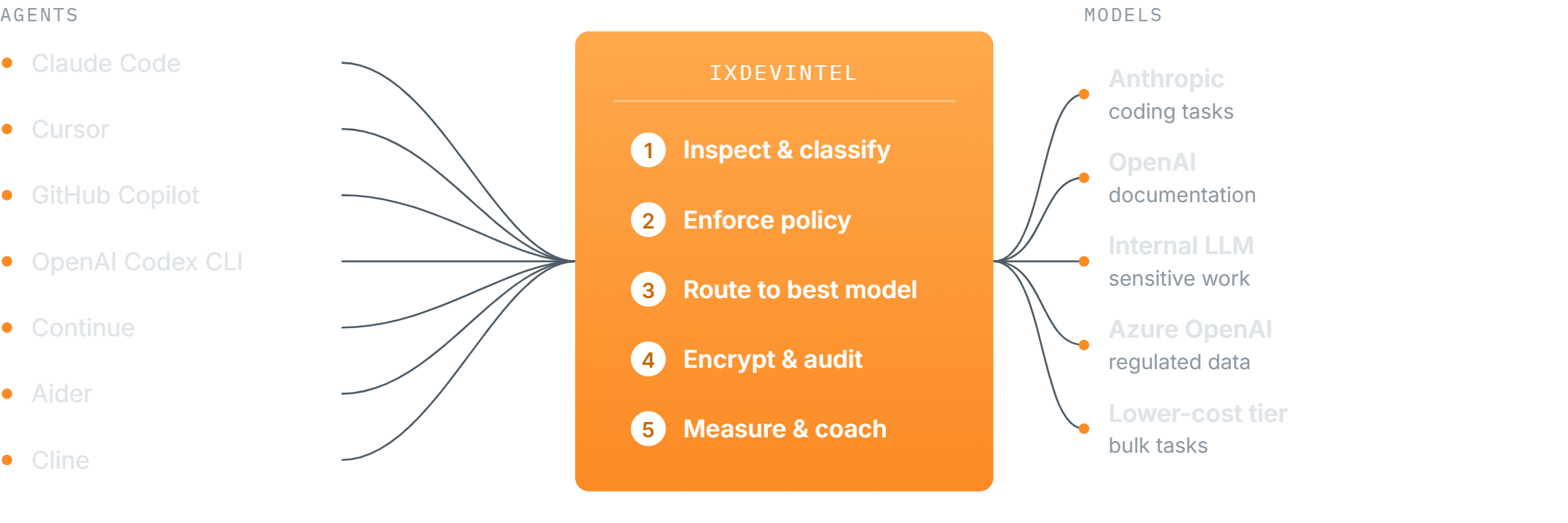
Control. Cost. Capability.
Five capabilities - gateway and routing, policy governance, security and compliance, usage intelligence, learning and maturity - delivered through one integration and organised below by the outcome each stakeholder owns.
For the CISO
Control
Know what leaves the perimeter, and prove it.
- Graduated policy - monitor, warn, soft-block or hard-block by content, sensitivity or team.
- Preview-first redaction before egress; sensitive prompts route to internal models rather than being denied.
- Encrypted audit with admin-approved raw access, and every access itself logged.
- Honest coverage - governed, partial or blind, reported per tool. No implied total visibility.
For the CFO
Cost intelligence
Pay for the model each task actually needs.
- Model routing to cloud or self-hosted models, matched to task type and sensitivity.
- Context reduction strips unnecessary payload before it becomes billable tokens.
- Cache attribution reuses previously generated code instead of paying twice.
- Quotas and seat rightsizing against real activity, not licence counts.
For the CTO
Capability intelligence
Turn individual proficiency into organisational capability.
- Contextual nudges in the IDE - credentials, token limits, oversized context, missing tickets.
- Shared project memory preserves knowledge and prevents duplicate work.
- Full attribution of AI activity to developers, teams, projects, repositories, tickets, agents and models.
- Session-arc analysis spots struggling patterns across multi-step tasks.
- Maturity ladder with evidence-based progression, not self-reported scores.
The evidence your security team will ask for
Specifications rather than adjectives. This section is written to be forwarded to a CISO without translation.
| Control | Implementation |
|---|---|
| Prompt inspection and redaction | Preview-first redaction. Sensitive patterns detected before egress; rules configurable per project and per team. |
| Encrypted audit log | AES-GCM encrypted payloads with key rotation support. Metadata-only storage available where full payload retention is not permitted. |
| Controlled access | Raw prompt viewing requires administrator approval; redacted previews are the default. Every access event is logged with actor, timestamp and stated reason. |
| Retention controls | Retention windows set per team and per project. Metadata-only mode for regulated codebases, with configurable purge policy. |
| Policy enforcement | Four graduated modes - monitor, warn, soft-block, hard-block. Sensitive prompts route to approved internal models rather than being denied outright, so developers do not route around the control. |
| Coverage reporting | Per-tool status reported explicitly as governed, partial or blind - including what the platform cannot see. |
Adoption becomes a programme, not a rumour
The capability no gateway or analytics platform offers: evidence-based progression that moves an engineering organisation up the curve one level at a time. Progression is earned through real work - never through individual scoring.
Beginner
Onboarding, responsible use, first governed requests.
Exploratory
Range across planning, documentation and coding work.
Task-specific
Depth in focused tasks, proven by a first project.
Agentic
Bounded delegation to agents with verified results.
Team system
Reusable practice with measurable team impact.
Why not just an AI gateway?
What the market offers today
Gateways route application LLM traffic and treat coding agents as generic API calls - quietly breaking the advanced features developers rely on. Engineering analytics platforms measure developers but govern nothing: no routing, no policy, no security controls.
What IXDevIntel does differently
Purpose-built for coding agents, and it does both halves. The same engine that enforces policy produces the usage intelligence - so there is one integration, one source of truth, and no reconciliation between tools that disagree.
Start with an Observe-First Pilot
A low-risk, reversible path: observe, then govern, then measure, then scale. Phase 1 needs no policy decisions and no developer communication.
Observe
Deploy in monitor-only mode with one team. No enforcement, no workflow change, fully reversible.
Govern
Redaction and routing policy go live. Encrypted audit begins. Security signs off on the evidence.
Measure
Usage dashboards live. Spend attributed by team and project. First quantified baseline established.
Scale
Maturity programme rolls out across teams. Adoption becomes a repeatable, measurable capability.
Your developers are already using AI. Now govern it.
See. Secure. Control. Measure. Scale.
Bring one team. We deploy in monitor-only mode, change nothing about how they work, and show you what your organisation is actually doing with AI. Reversible at any point.